
Criminal Cases in Gilmer County Courts
Gilmer Superior Court has felony-trial jurisdiction. It sits in the Appalachian Judicial Circuit with Fannin and Pickens, and circuit judges serve all three counties. The Gilmer County clerk, however, maintains the Gilmer files. The official county page identifies Amy E. Johnson as Superior and Juvenile Court Clerk and Ellen Sablain as the deputy for criminal records. Call 706-635-4462 before visiting 1 Broad Street because official pages conflict between Suite 203 and Suite 102.
Magistrate Court handles arrest warrants, first appearances, preliminary criminal work, and ordinance matters within its jurisdiction. Ellijay and East Ellijay municipal courts hold their city citation and limited misdemeanor records. Probate has a limited traffic-related route but is not the felony clerk. A search of Gilmer County Superior Court should not be expected to contain every city citation or preliminary file.
Choose the Right Gilmer County Court
The court name on a citation, charging paper, bond document, or hearing notice is the best starting clue. A felony accusation or indictment points to Superior Court. A warrant or first-appearance record may begin with Magistrate. A citation naming the Municipal Court of the City of Ellijay remains with that court unless later proceedings move elsewhere.
| Court or office | Criminal role | Contact |
|---|---|---|
| Gilmer Superior Court Clerk | Felony files and restricted juvenile files | 1 Broad Street; 706-635-4462 |
| Gilmer Magistrate Court | Warrants, first appearances, preliminary and ordinance matters | 1 Broad Street, Suite 203; 706-635-2515 |
| Ellijay Municipal Court | Ellijay and qualifying GSP citations | 197 N Main Street; 706-635-4711 ext. 1 |
| East Ellijay Municipal Court | Traffic and some misdemeanors | 107 East Oak Street; 706-276-3111 |
| Gilmer Probate Court | Limited traffic-related route, not felony files | 1 Broad Street, Suite 204; 706-635-4763 |
How to Search Gilmer County Case Records
The official Georgia Courts E-Access directory lists Gilmer Superior Court and routes readers to its participating provider. PeachCourt's criminal-availability list includes Gilmer Superior. The provider requires an account, and document access or filing may involve charges. The research could not inspect the account-gated search form, so field requirements should be read from the live provider rather than guessed.
- Identify the court from the citation, charge, incident location, or prior notice.
- For a felony, open E-Access, choose Gilmer Superior, and follow the provider route.
- Create an account if required and enter only the identifiers the live form requests.
- Read the docket as an index, then inspect the charging paper, disposition, judgment, and sentence.
- Call the clerk with the name, approximate year, and case number when the online record is absent or unclear.
| Search item | Use | Availability note |
|---|---|---|
| Court and county | Select Gilmer Superior for a local felony | Route begins at E-Access |
| Party identifiers | Use the live form's accepted name fields | Exact fields are account-gated |
| Case number | Best identifier when known | Format must match provider rules |
| Approximate filing year | Helps the clerk locate older material | Provide by phone if needed |
| Document choice | Docket, accusation, judgment, or sentence | Images may carry provider fees |
Gilmer County Cases in PeachCourt
PeachCourt is an electronic access and filing provider, not the custodian that replaces the clerk. Its official availability material includes Gilmer Superior criminal matters, but access requires an account. It should not be described as anonymous, free, or comprehensive. A docket entry can exist without a public document image, and older or archived papers may not be imaged.
The official PeachCourt page shown below is the source for the provider route.

If PeachCourt does not display the needed Gilmer County case or paper, call the Superior Clerk. Ask whether the file is older, archived, paper-only, not imaged, restricted, or sealed, and whether a plain or certified copy is available.
What the Gilmer County Case File Shows
A criminal court file is richer than a booking summary because it records how filed charges moved through court. The most useful documents are usually the accusation or indictment, docket, plea or trial disposition, judgment, sentence, and later orders. Each charge can have a separate outcome, so do not reduce the whole case to one line.
| Case number and court | The local file identifier, county, court, filing date, and defendant display. |
|---|---|
| Charging document | Accusation or indictment, offense description, statute, and any arrest or OTN cross-reference. |
| Docket entries | Filed motions, orders, notices, appearances, and other procedural events. |
| Hearing dates | Arraignment, pretrial, plea, trial, and sentencing settings where recorded. |
| Disposition and judgment | Conviction, dismissal, nolle prosequi, acquittal, dead docket, or other result by charge. |
| Sentence and conditions | Confinement, probation, fines, restitution, and concurrent or consecutive terms. |
Read the Gilmer County Charging Paper
The booking charge is an initial label, not the final court charge. Police and jail staff create records at arrest and intake. The district attorney later decides whether and how to accuse or seek an indictment. That decision can narrow, revise, add, or decline charges. For this reason, the accusation or indictment should be read before drawing a conclusion from an arrest listing.
The same caution applies to disposition. A docket line such as nolle prosequi means the prosecutor formally stopped that charge at that time. Dead docket means the prosecution was placed inactive, not necessarily finally adjudicated. No bill means a grand jury declined to indict the proposed charge. A judgment and sentence, rather than the booking page, shows a conviction and its consequence.
Stages of a Gilmer County Criminal Case
A Gilmer County felony file develops as allegations become filed charges and the court resolves them. Not every case includes a trial, and a dismissal or plea can end the process earlier. Timing depends on the case, court schedule, motions, and whether evidence or competency issues require more work; no local universal timeline was found.
Case flow: Charges Filed › Arraignment › Pretrial › Plea or Trial › Disposition › Sentencing
Magistrate warrant and preliminary records may precede the Superior Court file. The docket then records appearances and filings, while the charging paper defines what is actually before the court. After disposition, the court or another justice agency reports the outcome so GCIC can associate it with the arrest cycle.
Older Gilmer County Court Files
A missing online result does not prove that no Gilmer County case exists. The electronic provider may lack an older, archived, paper-only, or non-imaged document. Account settings and provider coverage can also affect what the user sees. The clerk is the authoritative fallback for these gaps.
Call 706-635-4462 with the full name, approximate filing year, and case number when known. Ask whether the clerk can locate the docket or file, whether inspection or electronic delivery is available, and whether the needed copy must be certified. No official local criminal-copy price was confirmed, so request a quote instead of applying another county's fee. The official clerk page shown below identifies the local office.
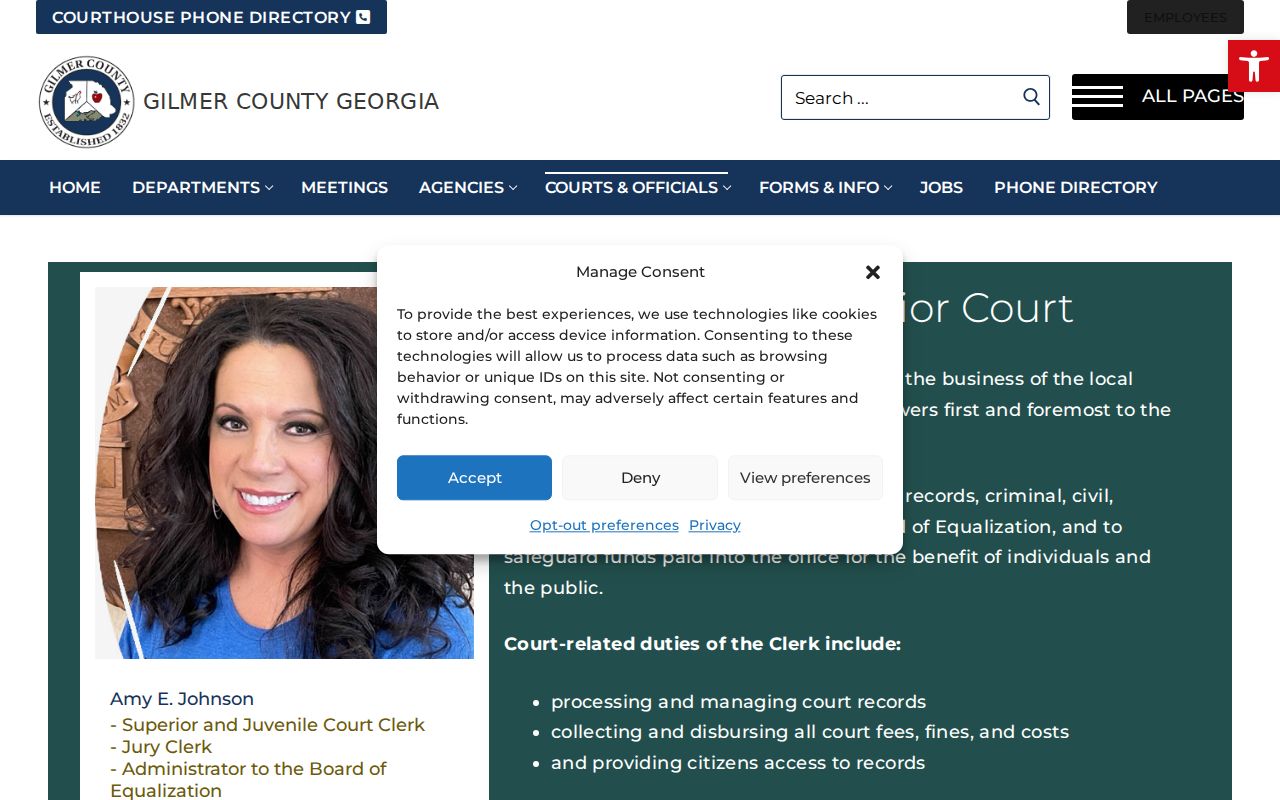
Confirm the suite and current counter arrangements before travel because the official local pages have not been consistent on the suite number.
Gilmer County in the Appalachian Circuit
Gilmer County shares circuit judges and the district attorney with Fannin and Pickens, but it does not merge its county files with theirs. The Gilmer Clerk maintains Gilmer cases. The circuit structure matters when reading a document that names an Appalachian Judicial Circuit judge, prosecutor, or program while the file remains a Gilmer County court record.
The circuit also operates Adult Drug Court, Veterans Treatment Court, HELP mental-health court, and Parental Accountability Court. Orders relating to an eligible participant may appear in the case record, but the program page is not a person search. HELP stands for Health, Empowerment, Life, Productivity and provides intensive court-supervised treatment in qualifying cases.
The official Appalachian Judicial Circuit page shown below identifies the circuit and its programs.
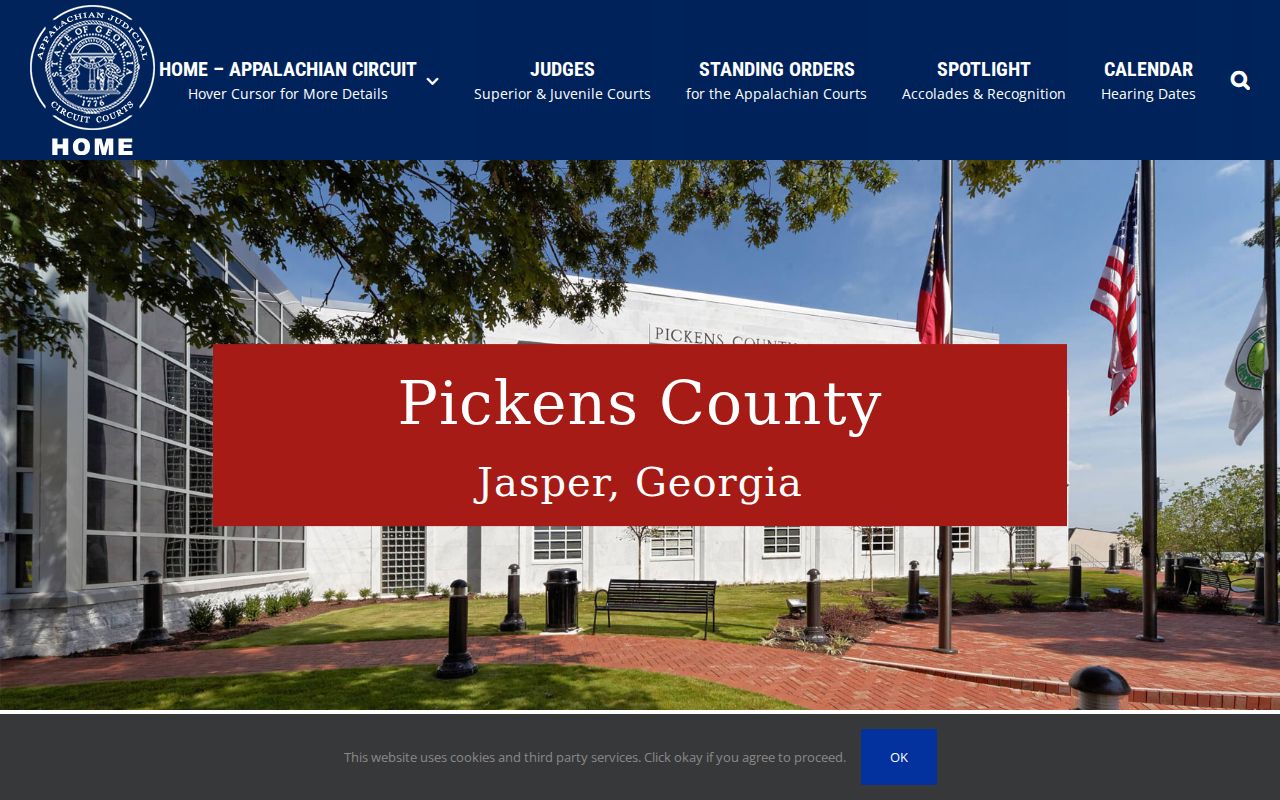
Use the circuit page for institutional context and the Gilmer County Clerk for the actual local case file.
Gilmer County Dispositions Reach GCIC
A final Gilmer County outcome must flow back to the Georgia Crime Information Center to complete the related arrest cycle. Courts, prosecutors, corrections, probation, and parole agencies all contribute parts of the statewide record. A delay or omission can leave an arrest looking unresolved even when the local case ended.
Georgia AOC's Criminal Case Data Exchange dashboard measures disposition transmissions by OTN and supports state, court-class, county, and table views. It refreshes about every 60 days. It is a system-performance dashboard, not a person search. When a personal history lacks the outcome, obtain the Gilmer County judgment or source-agency letter and follow GBI's challenge process. The source agency must correct or transmit its data; the dashboard cannot edit an individual record.
Gilmer County Case Record Access and Restrictions
Uniform Superior Court Rule 21 presumes court records are public unless law or a court order limits access. A sealing order requires the privacy harm clearly to outweigh the public interest. The presumption does not make every field or every case public. Juvenile records, protected victim or minor information, Social Security numbers, financial account data, and sealed or restricted material can be withheld or redacted.
Online access can be narrower than access at the clerk, and a missing image can reflect provider limits rather than a sealing order. Ask the clerk about the record's status instead of assuming why it is absent. If part of a record is withheld, ask for the legal basis and any segregable public portion. Georgia record restriction limits specified criminal-history dissemination but does not automatically destroy every local source document; a court file may need separate sealing treatment.
Rule 21 and Gilmer County Sealing
Record restriction under O.C.G.A. § 35-3-37 and sealing under Rule 21 address related but distinct views. Restriction changes ordinary dissemination of qualifying criminal-history information. Court sealing addresses access to the court record under a judicial standard. A person who receives relief should check both the GCIC history and the Gilmer County docket rather than assume one action changed every system.
Common potentially qualifying nonconviction outcomes identified by GBI include dismissal, no bill, nolle prosequi, dead docket, and no record on file, but the statutory process depends on the date and facts. A missing disposition should be corrected first. Clerk staff can explain copies and filing mechanics, but a disputed or conviction-based request may require legal advice beyond the clerk's role.
The Georgia Courts E-Access directory shown below confirms the official route to participating local systems.
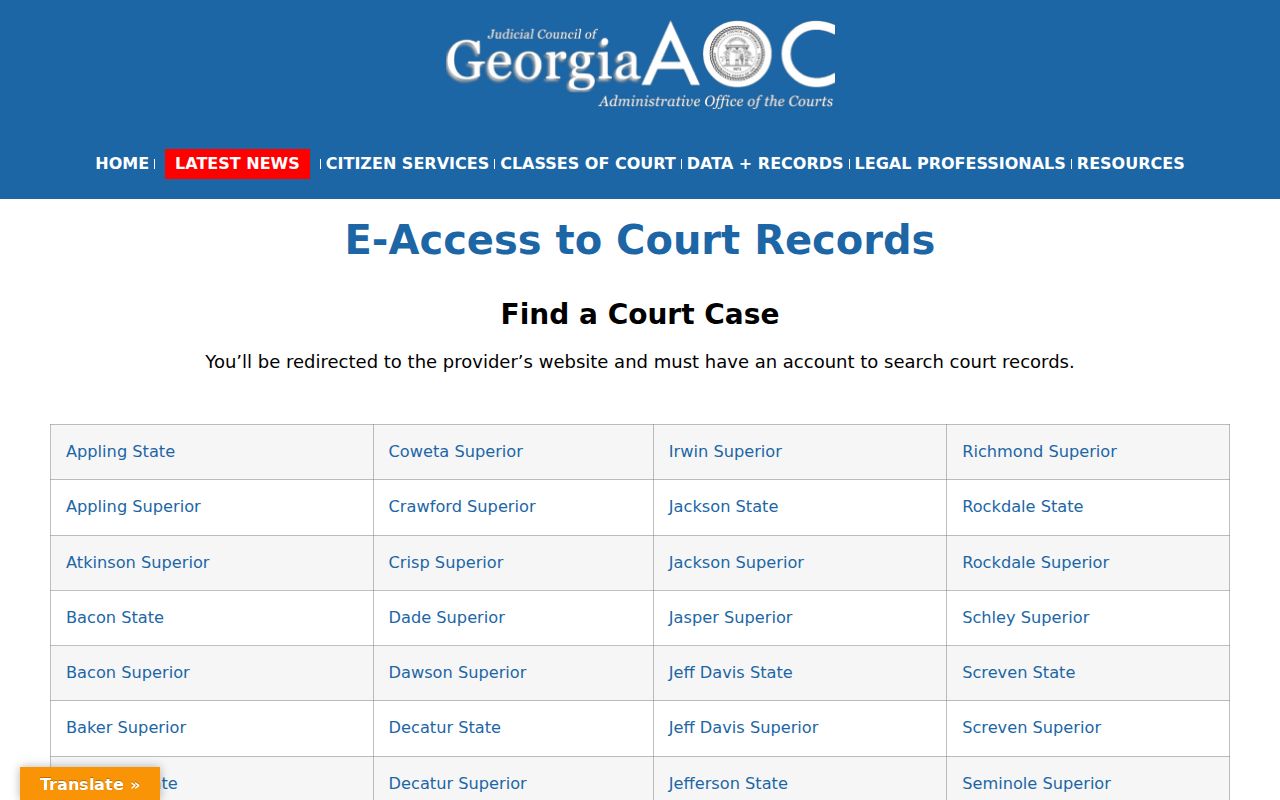
The directory is a route to the provider, while the clerk remains the source for access-status and certified-copy questions.