
Running a Sex Offender Check in Gilmer County
The Georgia Sex Offender Registry is the main county search channel. The Georgia Bureau of Investigation manages it with data supplied by sheriffs, corrections, parole, and other authorized agencies. The registry updates daily, while sheriffs must enter reported changes within two business days.
Use the state portal for a person or location search. Contact the Gilmer County Sheriff at 706-635-4162 for local registration questions or a suspected wrong address. For someone who may have moved across a state line, add the U.S. Department of Justice national search. A listing records a registration duty tied to a qualifying conviction. It does not report current criminal conduct.
Gilmer Registry Updates and Delays
“Updated daily” does not mean every reported change appears at once. The local sheriff first receives and enters registration information. A person may also be newly registering, outside Georgia’s requirements, legally removed, deceased, or absent because the search criteria were wrong.
GBI’s registry FAQ explains these limits and the update process.
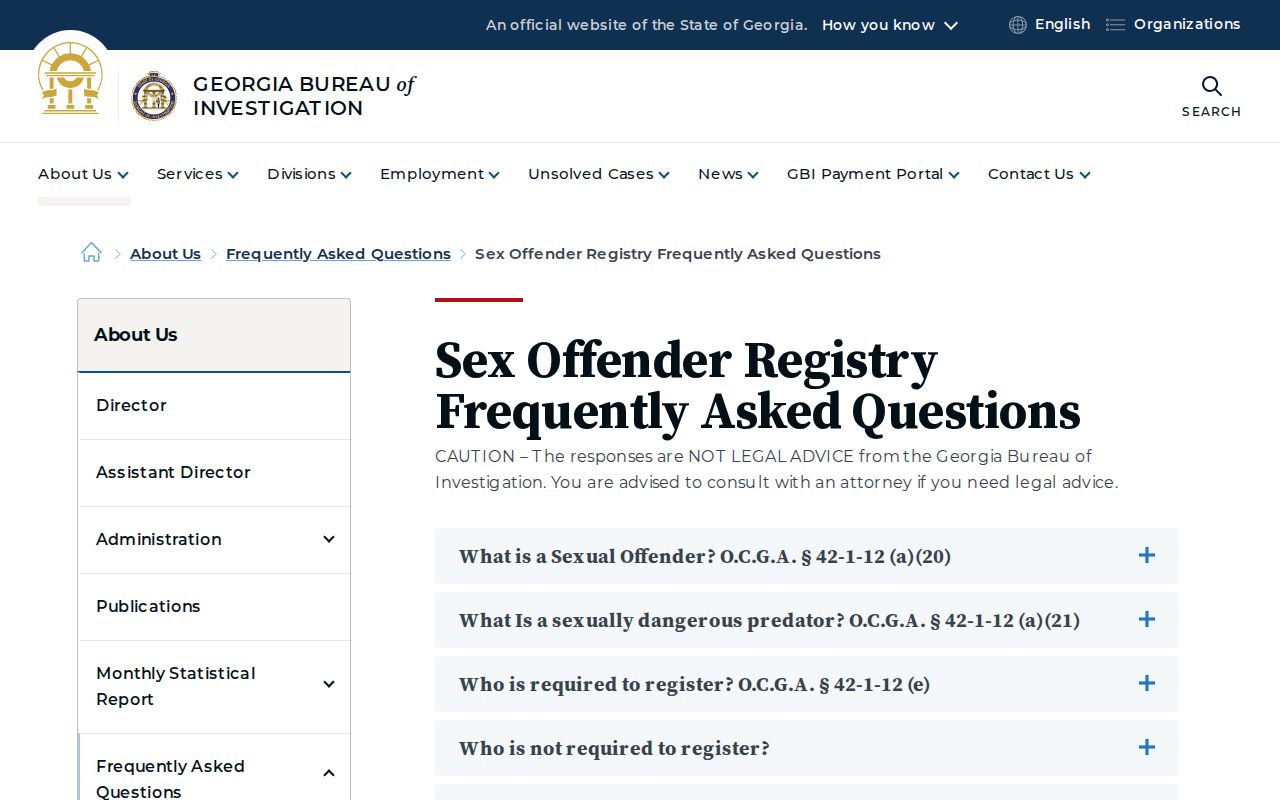
The FAQ image is a reminder to check spelling, broaden the location, and verify with the sheriff before drawing a conclusion from no result.
Searching the Georgia Sex Offender Registry
The live interface supports person and location searches. Portal rendering prevented stable extraction of every dropdown and radius value during research, so use the labels displayed on the current form and do not assume a fixed distance option.
- Open the official Georgia registry and review its conditions of use.
- Choose a person or location search, then enter the known name or Gilmer County location details.
- Review the result list and compare identifiers before selecting a profile.
- Open the profile and read the offense, address, status, risk assessment, and last-update fields together.
| Search control | Type | Required | Use |
|---|---|---|---|
| Name | Text | Depends on search mode | Person search; try spelling variants where appropriate |
| County | Location filter | No | Select Gilmer for county-focused results |
| City, ZIP, or address | Location text | Depends on mode | Neighborhood or address-based search |
| Radius or map/list | Location control | No | Use only values shown by the live portal |
| Type or status | Filter | No | Narrow results where the current interface offers it |
The official Georgia registry interface supplied the successful search image below.
The search screen demonstrates why the current controls, not a copied list of old fields, should govern each lookup.
Why a Gilmer Search May Fail
An empty registry result is not a broad criminal-history clearance. GBI notes several possible reasons: the person may not meet Georgia’s registration rules, may be newly registering but not yet submitted, may have died or been deleted, or may have completed qualifying First Offender treatment. Search terms can also be wrong.
Start with fewer fields, check aliases, and try both person and location modes. If a specific Gilmer County address appears wrong, report the concern to the sheriff. Do not confront the resident or infer a violation from a stale page.
Location boundaries create another trap. A postal city name does not always identify the police jurisdiction around Ellijay, East Ellijay, and unincorporated Gilmer County. Search the address and nearby area, then read the registering-sheriff field on a possible match. If concern remains, give the sheriff the exact address, profile link, and date viewed. Those facts are more useful than a cropped image with no location details.
What a Registry Profile Shows
A public profile joins identity, location, conviction, and registration data. Some fields appear only when supplied or legally public. Read the last update and registering sheriff with the address because those fields help show how current the entry may be.
| Name and aliases | Registered identity and other reported names. |
|---|---|
| Photo and description | Current image, date of birth, and physical identifiers when public. |
| Registered location | Residence or sleeping-location information permitted by law. |
| Work, school, vehicles | Required employment, education, or vehicle information when displayed. |
| Offense | Qualifying conviction, statute, and jurisdiction information. |
| Risk assessment | Level I, Level II, or sexually dangerous predator when classified. |
| Status | Compliance, registration, update, and sheriff details where shown. |
Scars, marks, and tattoos may help distinguish people with similar names. A profile is not a complete rap sheet and should never be treated as a current-offense report.
Gilmer Searches Across State Lines
The Dru Sjodin National Sex Offender Public Website, or NSOPW, searches participating jurisdiction registries through one federal gateway. It is useful when a person may live, work, or have registration history outside Georgia. Georgia’s portal remains the better source for the state’s own fields and update rules.
The Department of Justice NSOPW gateway supplied the national-search image.
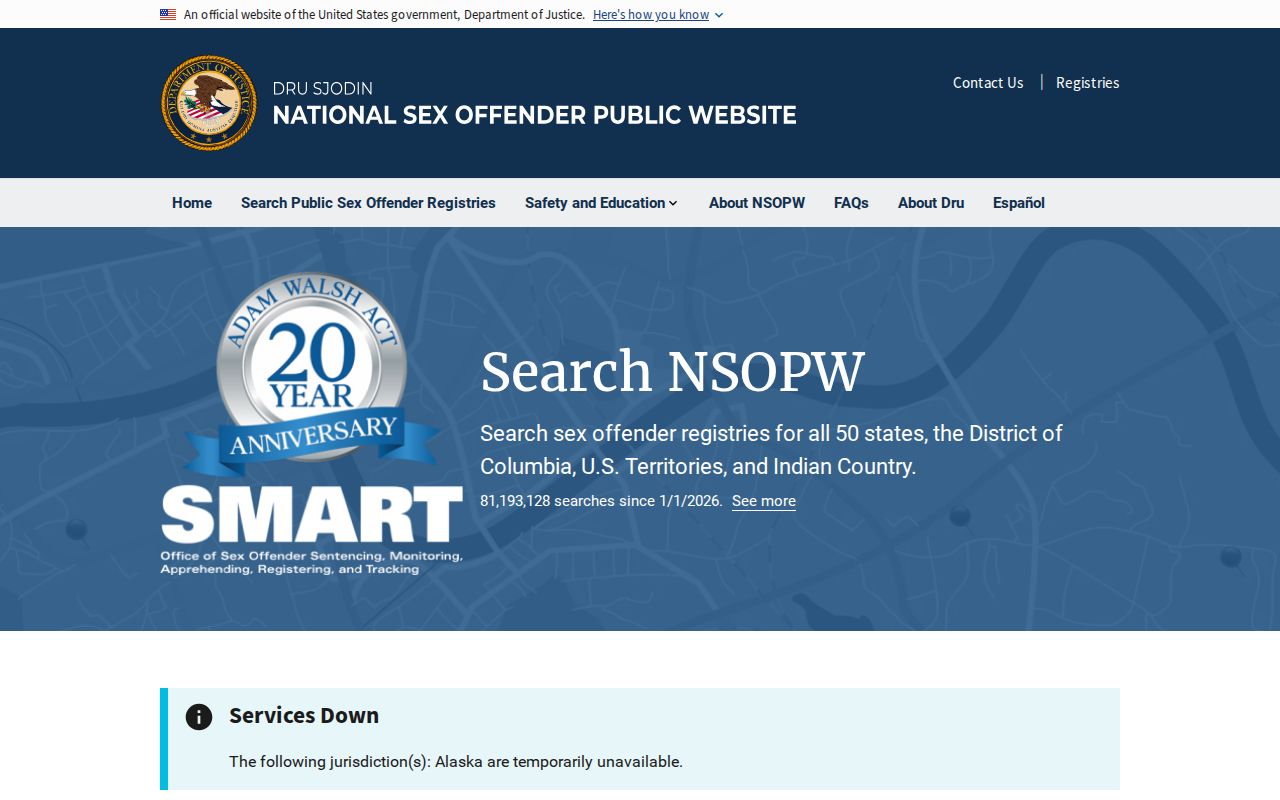
The national layer broadens geographic coverage, but any matching profile should still be opened at its originating jurisdiction and read in context.
Registration Requirements and Levels in Georgia
Georgia risk assessments are not the federal shorthand of 10-year, 25-year, and lifetime tiers. Registration is generally for life unless a statute or court order provides relief. The state’s three designations describe assessed risk, not fixed federal registration terms.
| Georgia designation | Duration or public point | Reporting |
|---|---|---|
| Level I | Lower assessed likelihood relative to higher categories; no automatic federal 10-year label | Annual birthday renewal and event-driven updates |
| Level II | Intermediate or higher risk under Georgia criteria; no automatic 25-year label | Annual birthday renewal and event-driven updates |
| Sexually dangerous predator | Generally lifetime unless legally relieved | Annual renewal plus an additional six-month reporting duty |
Initial in-person registration is required within 72 hours of release, placement on probation or parole, or entry into Georgia. Registrants renew in person within the 72 hours before their birthday for a new photo and fingerprints. Changes generally must be reported within 72 hours. Juveniles do not register unless tried and convicted as adults.
Gilmer’s Cohort-Specific Distance Rule
Georgia’s 1,000-foot residency restriction in O.C.G.A. § 42-1-17 varies by offense-date cohort. It must not be applied as though every Gilmer County registrant has the same restriction. The controlling conviction date, statute, and court history matter.
The GBI’s official residency-restriction page is the proper starting point for the statutory text. For an address-specific legal question, verify the person’s cohort and obtain legal advice rather than measuring a map and assuming a violation.
Gilmer Registry Release Petitions
O.C.G.A. § 42-1-19 allows some eligible people to petition the Superior Court of conviction. A person with an out-of-state conviction may use the court of residence in circumstances set by the statute. Copies go to the district attorney and sheriffs. A denial generally prevents another petition for two years.
Some paths require ten years after all custody and supervision have ended or depend on a Level I classification. Relief is not automatic. The official Georgia registry statute materials and the court file control. A successful petition changes legal status; simply disappearing from one search result does not prove why a profile is absent.
Lawful Use and Community Notification
Registry information supports personal, family, and community safety. Verify an address through the official profile, report a suspected discrepancy to Gilmer County Sheriff, and let law enforcement assess compliance. Never publish accusations based only on a map pin or confront a listed person.
Use registry data lawfully: Georgia law prohibits using registry information to harass, threaten, or intimidate a registrant or household. Do not use it for vigilantism or unlawful discrimination.
A registration violation can carry serious penalties, but only officials and courts determine whether one occurred. Keep the inquiry factual: note the profile URL, the questioned address, and the date observed, then call the sheriff.
Note: A registry listing reflects a qualifying past conviction and registration duty, not proof of a new offense.